10 myths about invisible braces — and the actual facts
Myths stay around surprisingly long
Aligners have been on the market for more than 25 years. Still, ideas float around in online forums, friend circles and sometimes in old magazine articles that have little to do with today's reality. We take the ten most common myths we meet in the practice — one by one.
Myth 1 — "Aligners are only for mild cases"
Partly true. Aligners do have limits — very severe crowding requiring extractions, major jaw shifts or heavy bite anomalies are not for invisible braces. But: for mild and moderate corrections in the front and canine area aligners are today clinically just as effective as fixed braces — and that covers the most common adult cases by far.
Myth 2 — "It probably hurts a lot"
Not true. Aligners apply gentle, continuous pressure — not a sudden tug like a tightened bracket wire. When switching to a new tray you feel pressure for 1–2 days, occasionally a mild tension. Painkillers are almost never needed. Compared with traditional braces (whose wire changes cause several painful days), aligners are much more comfortable.
Myth 3 — "I will lisp"
Rare and short-lived. The first 2–4 days you feel a small adjustment on the S sound. After that your tongue has adapted to the new mouth geometry — for most patients so fully that the environment notices nothing. For voice-critical jobs we plan the start individually.
Myth 4 — "Aligners are only for young people"
Definitely false. Our patients are between 18 and 75. Aligners don't require a specific age — they require healthy gums and sufficient bone. We verify both at the consultation with scan and X-ray. Someone 60 with mild crowding can be treated the same way as a 25-year-old.
Myth 5 — "Online aligners cost much less and do the same thing"
Not true and dangerous. Online aligners without a dental exam and X-ray miss caries, hidden root infections, periodontitis, loose teeth. The pressure of an aligner on an inflamed tooth can cause massive problems within weeks — up to tooth loss. A serious treatment doesn't cost "much more" — it costs what a real medical service costs. With us the easy package starts at €1,580 per jaw, one-time, or from €44/month.
Myth 6 — "Aligners are visible right away"
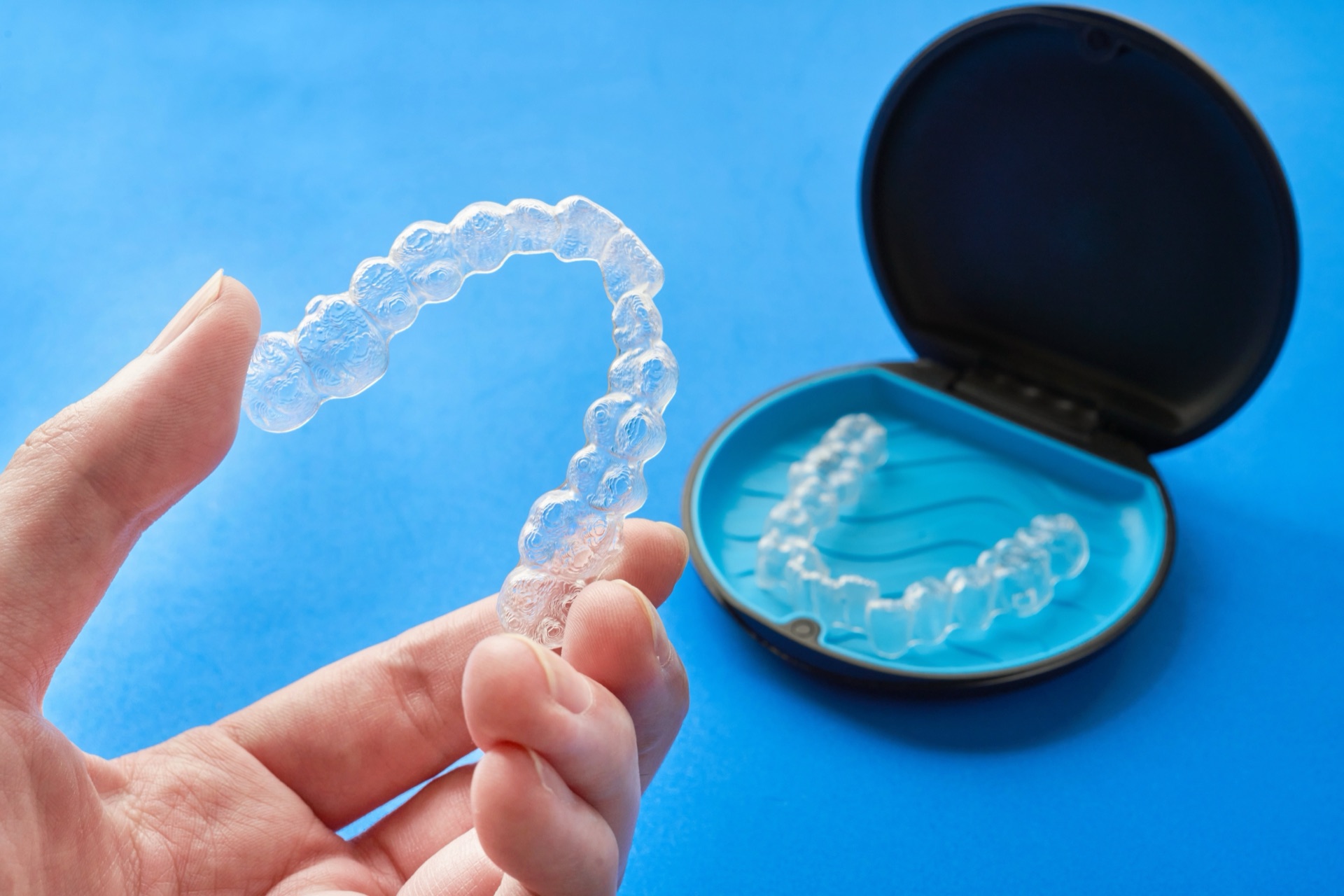
Not true. Aligners are made of thin, transparent plastic. On photos they are practically invisible. In conversation only at very short distance and with close looking. In daily work life almost nobody notices — that's the whole point.
Myth 7 — "Aligners don't hold — the teeth drift back anyway"
Only true if you neglect retention. After every tooth correction — whatever the method — teeth want to drift back. Only a retainer stops that: a thin bonded wire or a night retainer. Wear the retainer and you keep the result for life. Skip it and you eventually have the same problem as before. This has nothing to do with aligners — it applies to every tooth correction.
Myth 8 — "Aligners only work if you wear them 24 hours"
Close. The official recommendation is 22 hours per day — that leaves room for eating and brushing. The other two hours are planned. Going regularly down to 18 or 20 hours delays treatment — but anything over 22 hours isn't "better", because movement needs time to biologically take hold. More isn't more.
Myth 9 — "Aligners make my caries worse"
Not true — but lazy hygiene does. An aligner traps a thin film of saliva on the teeth. Putting trays on unbrushed teeth for hours gives caries bacteria optimal conditions. The fix is simple: brush after every meal, then aligners in. Do that and you have no higher caries risk during treatment.
Myth 10 — "I don't really need a correction, it's just vanity"
Rarely true. Crooked front teeth are not just an aesthetic topic. Crowding hampers cleaning, fosters caries and tartar, can lead to wear from uneven bite load, and TMJ issues. Gaps can grow. Rotations don't protect teeth optimally. Aligner therapy therefore always has a medical and an aesthetic component — both are legitimate.
What to take away
Aligners are today an established, safe and comparatively fast tool to correct teeth in the front and canine area. The method has clear limits — which we name openly at the consultation. But within those limits it's the best choice for the vast majority of adult patients.
If this post cleared a myth in your head: good. If it confirmed one: get in touch, we'll explain the context. In the free consultation we take time for your specific questions.
Practice Herrengasse 6–8, 1010 Vienna. 45 minutes, a scan, a preview of your smile — and honest answers.
Ready for your new smile?
Free consultation including iTero 3D scan and panoramic X-ray — Practice at Herrengasse 6–8, 1010 Vienna.
Book a free appointment