What are invisible aligners — and how do they work?
What invisible aligners actually are
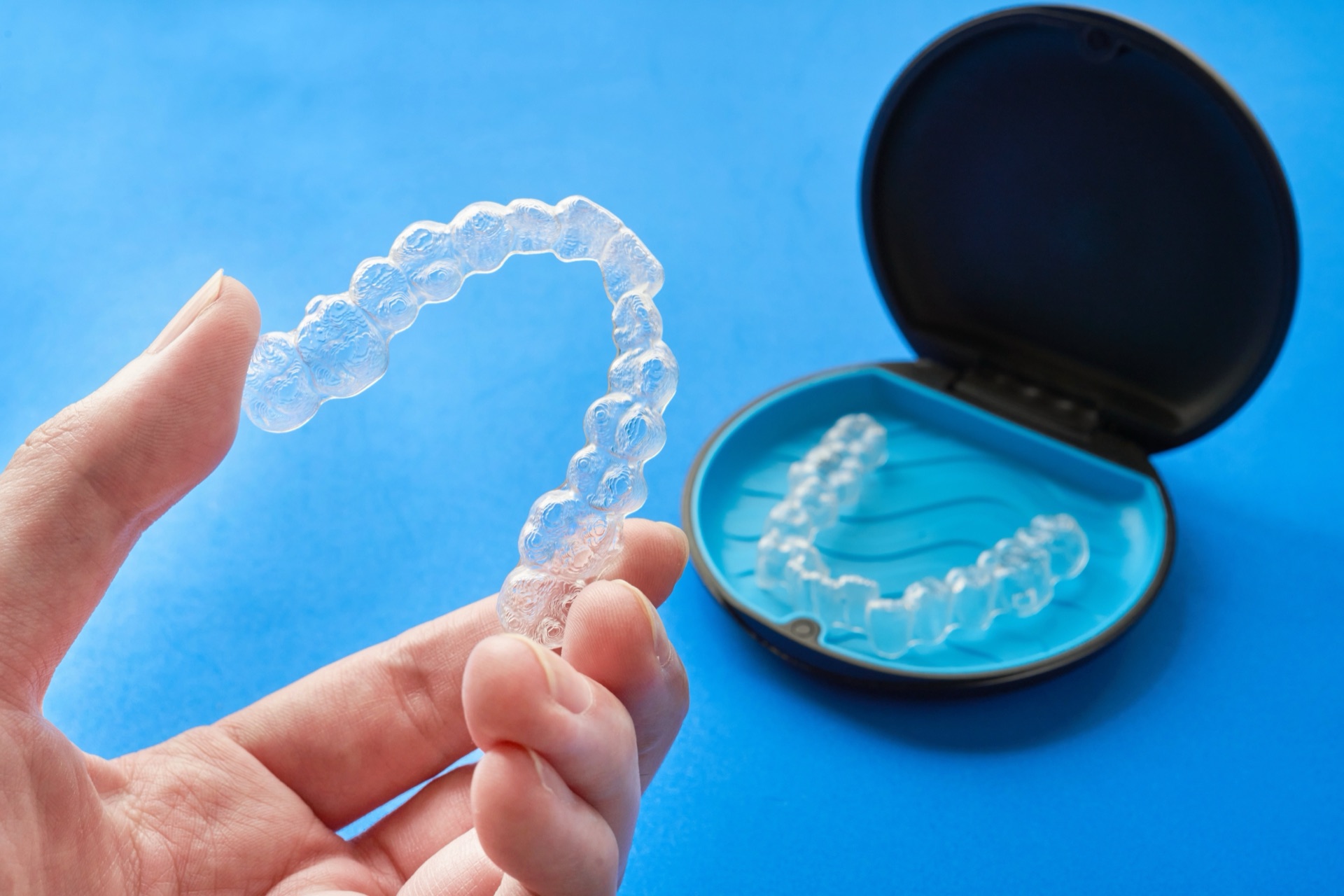
Invisible aligners — known in the dental world as clear aligners — are paper-thin, transparent plastic trays. You wear them over your teeth, very much like a delicate retainer. Unlike traditional braces with brackets and wires, aligners are practically invisible in everyday life. Whoever sits across from you might notice at second glance — and most of the time not even that.
Every aligner is a millimetre-precise step on the way to your target bite. You receive a whole series of them: for simple cases usually 10 trays, for moderate corrections around 20. Every one or two weeks you swap to the next aligner. Each new tray applies gentle pressure to specific teeth — and bit by bit they move to where they belong.
How aligners move your teeth
Teeth don't sit rigidly in the jaw. Bone and periodontal ligament are adaptable — and that's exactly what an aligner therapy uses. Each aligner is shaped so it sits slightly differently on a specific tooth than your current position. That small difference creates gentle, continuous pressure.
To make sure the force lands exactly where it should, we add small tooth-coloured attachments to certain teeth — composite dots a few millimetres wide that the aligner uses as leverage points. They're unobtrusive and removed without residue at the end of treatment.
Planning happens digitally. At your first appointment we scan your bite with an iTero 3D scanner — no putty impressions, no gag reflex. From the 3D model the software calculates the precise path of every individual tooth, and right during the consultation you see the projected end position. Only when you say yes does the order for your personal aligner series go out.
Who aligners are suitable for
Aligners are ideal for minor to moderate misalignments in the front and canine area:
- Crowding, slightly overlapping or rotated teeth
- Small gaps
- Mild overbite or underbite
- Relapse after braces in your teenage years
Severe misalignments that require major movement of large molars or jaw surgery are not the domain of aligner therapy — they need traditional orthodontics. At the initial consultation we tell you at a glance which category your case falls into — and we're honest if aligners are not the right tool.
Advantages at a glance
- Visually unobtrusive — no worries about how colleagues or clients perceive you.
- Removable — take them out for eating, brushing or important moments.
- Comfortable — no sharp brackets, no wires irritating your inner cheeks.
- Hygienic — you brush your teeth normally, no manoeuvring around brackets.
- Predictable — you know upfront how long treatment will take and what it costs.
What aligners are not
They are not ready-made trays from an online box. Every serious aligner plan stands on a dental examination, an X-ray and an actual diagnosis. Caries, a hidden root inflammation or periodontitis must be treated before the first tray — otherwise problems travel with the treatment and get worse.
That's exactly why every aligner therapy at our practice runs out of our own clinic in 1010 Vienna. You have a contact person the whole way — from the first conversation through the check-ups to the final retention.
What happens next
If you want to know whether aligners are right for you, the simplest first step is a free consultation incl. iTero scan and panoramic X-ray on Herrengasse. You get a clear answer and a live preview of your new smile — without obligation, without sales pressure.
In our next blog post we compare aligners side-by-side with traditional fixed braces — when each option is the better choice, and what to watch out for.
Ready for your new smile?
Free consultation including iTero 3D scan and panoramic X-ray — Practice at Herrengasse 6–8, 1010 Vienna.
Book a free appointment