Speaking with aligners — how long does adjustment really take?

The most common worry before treatment
At almost every consultation we hear the question: "Will I lisp with these? Will my voice sound different? Will my colleagues even be able to listen to me when I present?"
A fair worry. Speaking is intimate, professionally critical, identity-shaping. Nobody wants to sound different overnight. The good news: for most patients the impairment is mild and short — usually less than a week, often only 2–3 days.
What changes when speaking with aligners
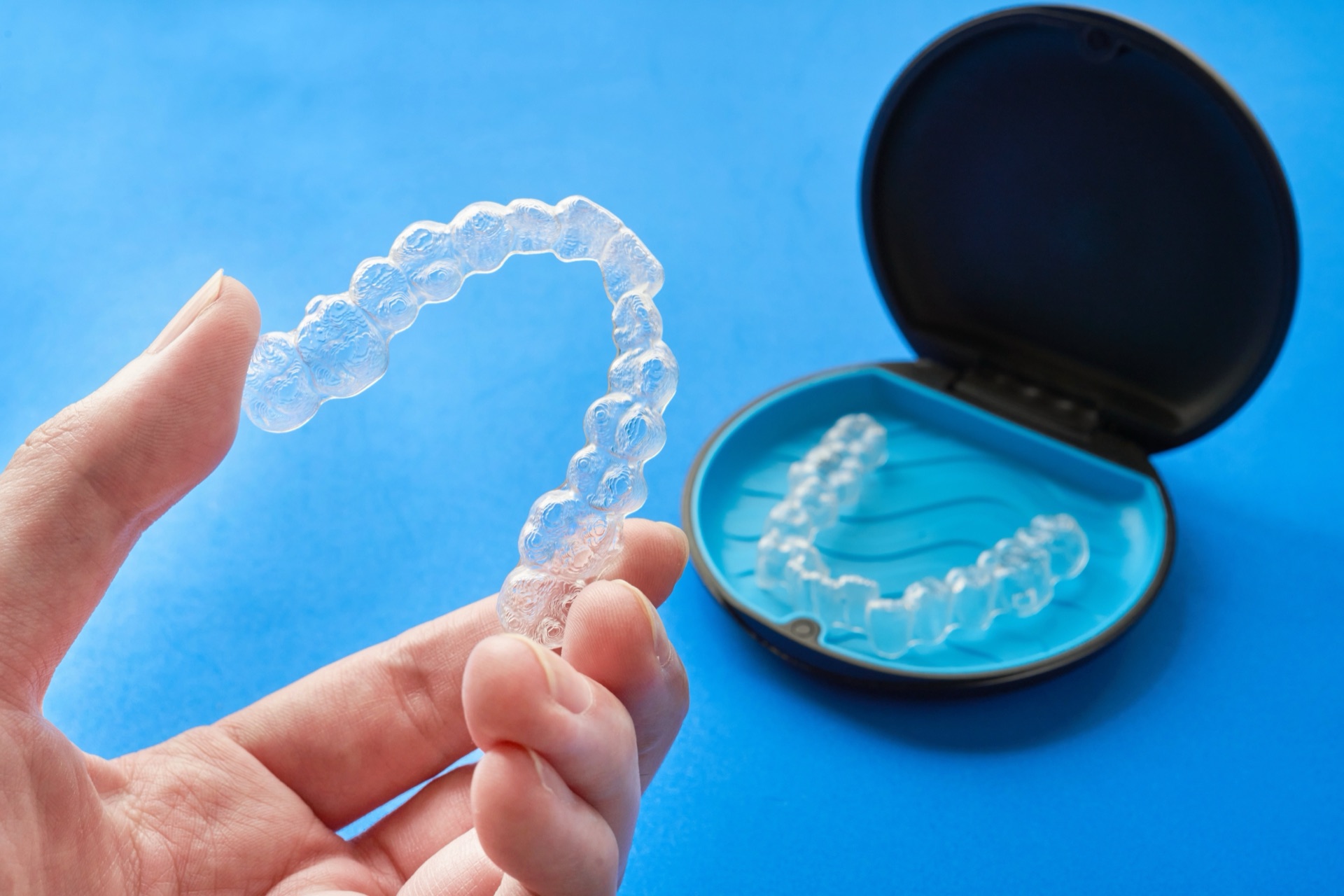
Aligners are paper-thin — typically 0.75 mm of material thickness. That's much less than older brace materials. Still, an aligner takes two things the tongue knew as "the world" slightly away:
- Smooth tooth surface — the tongue is used to lightly tapping or sliding against the teeth when speaking. With aligners the surface is minimally different.
- Inner mouth geometry — the tray sits on the inside of the upper incisors. That's exactly where the tongue forms contact for many sounds.
The result: especially S sounds, Z sounds and Sh sounds feel unfamiliar at first. Some patients lisp slightly, others barely notice, some just feel a "furry" mouth sensation.
What happens in the first days
Day 1 — the most intense day
When you put in your first aligner in the morning, the mouth feel is unfamiliar. The first words feel as if the tongue doesn't quite know where to go. In the mirror nothing shows. The person across only notices if they're paying close attention.
Tips for day 1:
- Few important calls scheduled if possible.
- Read aloud in front of the mirror — a few minutes of deliberate speaking speeds up adaptation enormously.
- Water close by — on day 1 you often produce more saliva and swallow more frequently.
Days 2 to 3 — adapting
The tongue adjusts. It learns: "Here's a smooth surface, here I can land, here I can't tap as before." The brain takes over the correction unconsciously. You speak increasingly naturally without thinking.
Days 4 to 7 — practically invisible
For most patients acoustic perception is essentially normal after a week. You still feel the tray, others hear nothing.
At each tray switch
Some patients notice a mild regression for a few hours after switching to a new aligner — the new tray sits differently, the tongue needs a moment to recalibrate. Normal and usually gone by evening.
Professions we plan around carefully
For patients whose voice is their tool we plan with extra care:
- Teachers, trainers, coaches — we recommend starting on a weekend so adjustment lands on free days.
- Speakers, actors, presenters — a short trial wearing before deciding, so you yourself hear what happens.
- Sales and high-call roles — perhaps start after an important sales week, not before.
We discuss this individually at the consultation. For very voice-sensitive roles a trial aligner also makes sense — wear it a few days to test how speaking feels — before scheduling the actual start.
Tips for fast adaptation
- Read aloud. 10 minutes a day, ideally texts with lots of S and Z sounds. Tongue twisters are fun and accelerate adaptation.
- Slow down deliberately. When a word gets hard, speak it slowly and clearly.
- Water. A dry mouth under aligners makes everything harder.
- Don't avoid speaking. If fear of lisping makes you switch to texting only, you extend adaptation. Speech is practice.
What if the impairment doesn't pass?
In very rare cases — particularly sensitive tongue papillae or unfamiliar aligner material — the unfamiliar mouth feel persists. Then we step in:
- Does the aligner sit too high against the gums? We trim slightly.
- Is an edge on an incisor uncomfortable? We polish.
- Material intolerance (extremely rare)? We switch.
99% of patients need no adjustment at all.
A last observation from practice
Many patients say in hindsight: "I had imagined the speaking effect worse than it was." This matches our experience — aligners are genuinely good here. Compared to traditional fixed braces, where brackets and wires form a much coarser obstacle for lips and tongue, the invisible tray is almost always the more pleasant experience.
Want to see for yourself? Come by the practice on Herrengasse — we'll show you the trays, you can even handle them and look in the mirror. Free consultation, 45 minutes.
Ready for your new smile?
Free consultation including iTero 3D scan and panoramic X-ray — Practice at Herrengasse 6–8, 1010 Vienna.
Book a free appointment