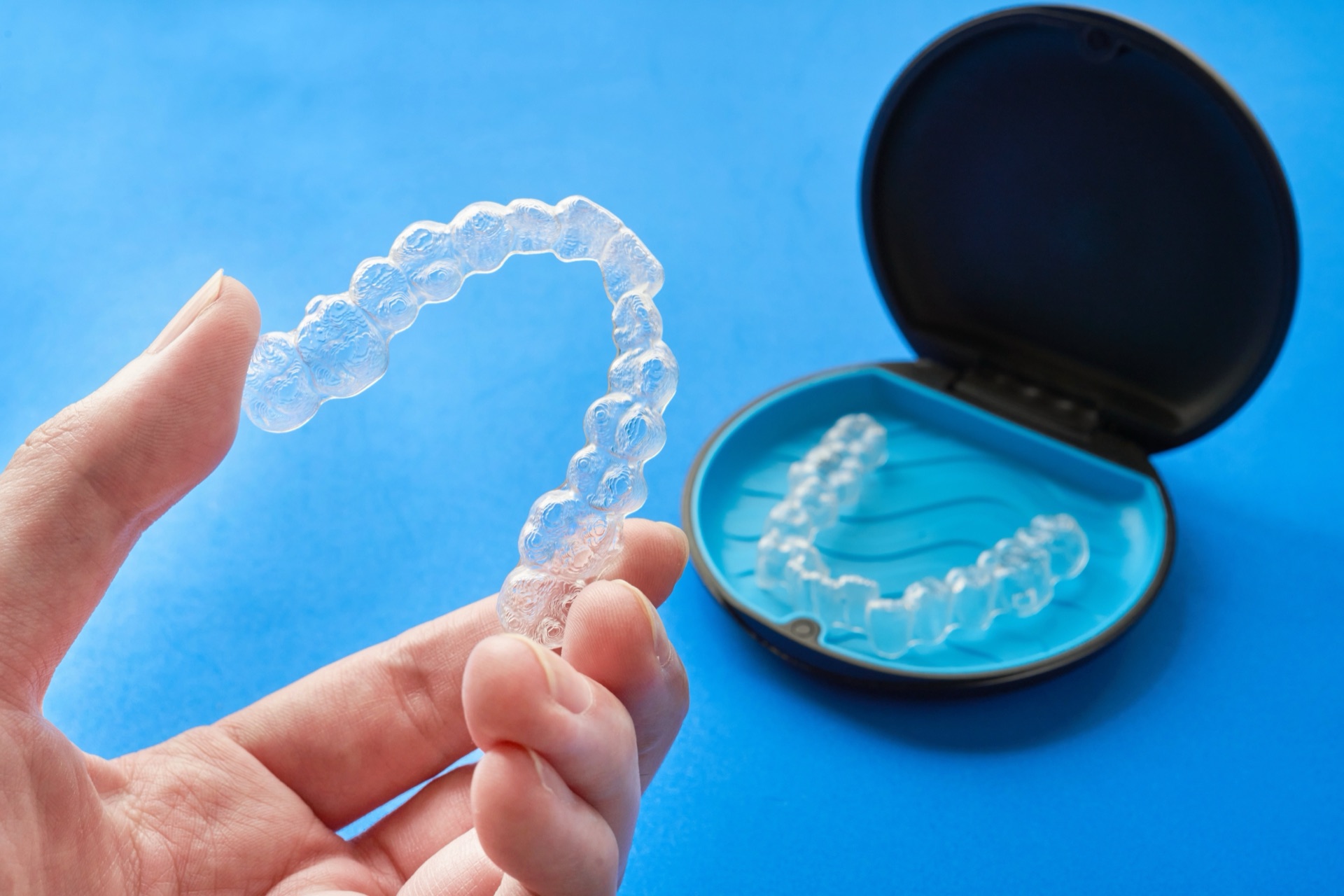
Retainers after aligner treatment — why they are essential

Why teeth drift back without retainers
Teeth aren't rigid structures. They sit in a periodontal ligament that stays plastic for life — and that's exactly what an aligner therapy exploits. What helps us during treatment works against us afterwards: without counter-pressure teeth migrate back toward their old position.
This is called relapse — and it doesn't happen over decades, but sometimes within weeks if no retention is in place. Three forces act:
- Periodontal memory. The fibres holding the tooth in the bone "remember" the old position.
- Mesial drift. Lifelong, teeth migrate slowly toward the jaw midline — a normal aging process.
- Muscle forces. Lips, tongue and cheeks press a little every day.
So retention isn't an extra. It's the second part of the treatment.
Two types of retainers
Depending on the case we use one of two options — often combined.
The bonded retainer wire (lingual retainer)
A thin, round or rectangular stainless steel wire bonded to the inside of the front teeth. Invisible from outside, felt by the tongue only the first few days, then not at all.
Advantages:
- Holds 24/7 with no effort from you
- No way to "forget"
- Optimal for the lower front teeth, which drift most
- Lasts 10+ years with good care
Disadvantages:
- Cleaning is a bit more demanding — floss needs threading
- If damaged it must be repaired promptly
The lingual retainer is our default for the lower front teeth after every aligner therapy.
The removable clear retainer
Looks like a final aligner — a thin, transparent tray you put in at night and take out in the morning.
Advantages:
- Completely invisible
- Easy to clean
- Sufficient for smaller corrections
Disadvantages:
- Requires discipline (every night!)
- Wears out after 1–3 years and needs replacement
- Can be lost or forgotten
We use this option mainly for the upper front teeth — and for patients who don't want a bonded wire for personal reasons.
How long do you have to wear retainers?
The honest answer in every serious textbook: for life.
That sounds like a lot. In practice it looks like this:
- Lingual wire: You stop noticing it after the first two weeks. It stays in, you just need to clean carefully around it.
- Clear retainer: First two months intensively (during the day if possible). Then for years one night per 24 hours suffices. Later reduction to 2–3 nights per week depending on stability — we discuss this at check-ups.
Stick to that and you keep the result of your aligner therapy for life. Stop after 6 months and you can expect a noticeable rebound within 2–3 years — and would need a short re-treatment.
How to care for retainers
The bonded wire
- Brush normally, gently around the bonded spots.
- Use floss with a threader or bridge floss once a day under the wire.
- Interdental brushes are an easy alternative — great for on the go.
- At your dental hygiene visit (1–2x per year) the area gets professional cleaning.
The removable retainer
- Like aligners: brush with liquid soap, no toothpaste, lukewarm water.
- Cleaning tablet once a week.
- Never in hot water or the dishwasher.
- Transport in the case it came in — the most common loss cause is napkins in restaurants.
What if the retainer breaks or gets lost?
Tell us immediately. A broken lingual wire must be replaced within days, otherwise that tooth has no retention. A lost night retainer is remade — we often need a new 3D scan.
Pro tip: keep your last aligner. In an emergency it's a temporary night retainer until the real one is made.
A word at the end
Retention isn't a detail. It's what secures the investment in your aligner therapy. A perfectly corrected front that is crooked again a year later is more frustrating than not starting at all.
We discuss the right retention strategy individually with every patient at the end of the active phase — and check it at every hygiene appointment.
Still questions or initial thoughts about an aligner treatment? Book your free consultation on Herrengasse — we take 45 minutes for you.
Ready for your new smile?
Free consultation including iTero 3D scan and panoramic X-ray — Practice at Herrengasse 6–8, 1010 Vienna.
Book a free appointment