Crowded teeth — causes and modern treatment
What crowding actually is
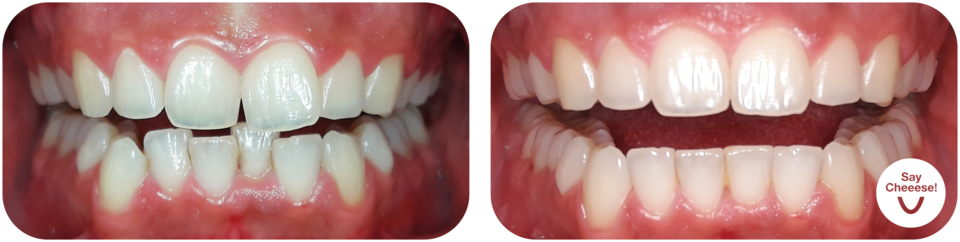
In crowding the teeth stand closer together than there is room in the jaw. Some teeth overlap their neighbours, others tilt inward or outward, individual ones rotate out of line.
In dental terminology there are three severity levels:
- Mild crowding: up to ~3 mm of space shortage — cosmetically noticeable but without bite issues.
- Moderate crowding: 3 to 5 mm — visible and often with hygienic consequences.
- Severe crowding: over 5 mm — usually requires extracting teeth or expanding the jaw.
Aligners are the method of choice for mild to moderate crowding — by far the most common case bringing adults to us.
Why crowding develops
Crowding rarely has a single cause; usually several factors combine.
Genetics
You inherit jaw shape from both parents, tooth size from both — and not infrequently a "mother's small jaw" meets "father's big teeth". You end up squaring the circle in your mouth.
Early tooth loss
If you lost a milk tooth too early as a child, the neighbouring teeth often drifted slightly. By the time the permanent tooth came through, its space was already half occupied.
Adult migration
Teeth migrate slowly toward the midline throughout life. This is called mesial drift. Especially after extractions without space management, neighbouring teeth wander — and what needs space at the back pushes things forward at the front.
Relapse after early braces
A classic: you had fixed braces at 14, but eventually stopped wearing the retainer. Over 10–20 years the front teeth slowly drifted back toward their original position — and got tighter.
What crowding does to you — beyond appearance
Crowding isn't just an aesthetic topic:
- Cleaning becomes hard. Overlapping teeth are difficult to floss. Plaque and buildup accumulate, raising the risk of caries and gum inflammation.
- Tartar accumulates. Especially on the inside of the lower front teeth, where saliva deposits a lot of minerals.
- Bite imbalance. Some teeth carry more load, others less. This can cause abrasion, small chips and over time TMJ issues.
- Loss of confidence. For many patients the actual main motive for treatment.
How aligners correct crowding
Aligners have three strategies to create space:
- Uprighting and aligning: Tilted teeth are stood straight. This frees up 0.5–1 mm per tooth.
- Arch expansion: The dental arch is gently widened. Limited as an adult, but enough for mild cases.
- IPR (interproximal reduction): At the contact surfaces of teeth we shave off hair-thin amounts with fine strips — usually 0.2–0.5 mm per contact point. Painless, harmless to the tooth (the enamel is thick at that spot anyway) and depending on the number of points creates 2–6 mm of total space.
We combine these as needed. At the consultation you see on the 3D model what happens where.
Treatment duration
Realistic time frames for the most common cases:
- Mild crowding (1–3 mm) with only small alignments: about 4 months with the easy package (10 aligners).
- Moderate crowding (3–5 mm) with arch expansion and IPR: about 8 months with the sensitive package (20 aligners).
- Severe crowding over 5 mm: not our scope — we recommend colleagues with fixed braces.
After treatment — retention is mandatory
Crowding tends to relapse — teeth want to return to their old position. That's why every patient gets a retainer, almost always as a thin bonded wire behind the lower front teeth. It sits hidden, invisible from outside, and stops the mesial drift.
For the upper teeth a clear night retainer usually suffices for the first years.
When is the right moment?
The moment your crowding starts to bother you. There's no biological age beyond which a correction is "too late" — we treat patients between 18 and 75. What matters is healthy gums and sufficient bone. Both we check at the consultation.
Drop by, get scanned, look at the possible end position. Appointments are free and without obligation.
Ready for your new smile?
Free consultation including iTero 3D scan and panoramic X-ray — Practice at Herrengasse 6–8, 1010 Vienna.
Book a free appointment