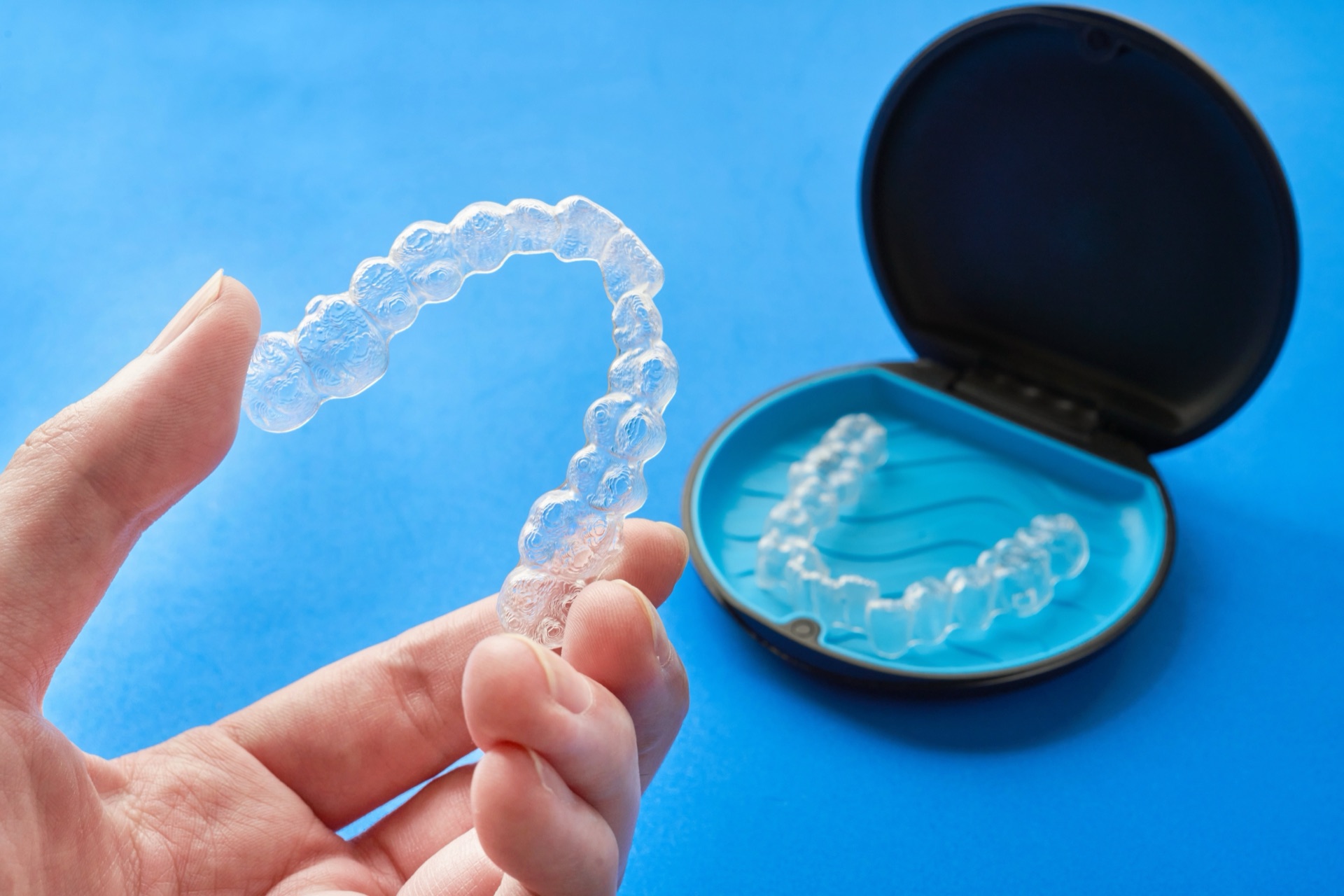
Fixing crooked front teeth — can aligners do it?
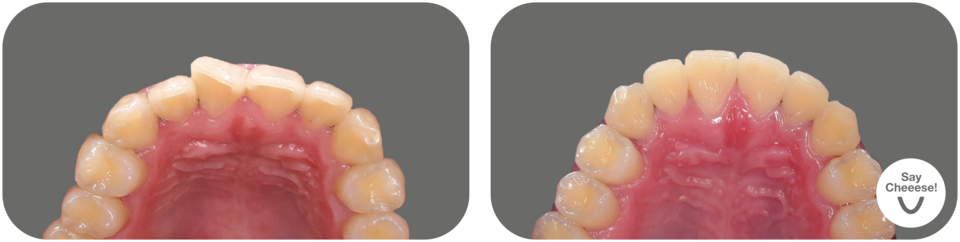
Front teeth — the most common reason people come to us
When someone walks into our practice on Herrengasse and says: "I don't like my teeth anymore", in 8 out of 10 cases the topic is the front teeth — upper and lower incisors and the canines. They're what you see in the mirror, what catches on photos, what shapes your smile in conversation.
That's exactly why they're also the area where aligners shine. Invisible braces are specialised in the precise micro-movements of the front and canine area — and there they're often the faster, gentler method than traditional braces.
What falls under "crooked front teeth"
In the practice we mainly see five variants:
- Crowding: Front teeth stand too close together. One pushes forward, the next backwards — they overlap slightly.
- Rotation: Individual teeth are twisted, often the lateral incisors or canines.
- Tilting: A tooth tips forward or backward, its tip not pointing straight down.
- Spacing: Small gaps between the front teeth — especially between the upper incisors (the famous diastema).
- Late relapse: You had fixed braces as a teenager and the front teeth slowly drifted back over the years.
In all these cases aligners are usually the first choice.
Why aligners do so well on front teeth
Front teeth have short, simple roots. Their movement in the jaw bone is highly plannable. The forces an aligner exerts are tailored exactly to these movements — gentle, continuous, with a low risk to the roots.
You also see the effect fastest on front teeth. The first visible changes often appear after 4–6 weeks — which boosts motivation for the rest of treatment.
How a typical front-tooth correction runs
Phase 1: plan
At the consultation we scan your bite and show you the projected end position on the 3D model. For mild crowding or a small gap the easy package with 10 aligners is usually enough. For stronger rotation or more movement the sensitive package with 20 aligners.
Phase 2: active wear
You change the trays yourself every one to two weeks at home. For some front teeth we add attachments — small tooth-coloured composite dots — so the aligners can grip precisely. They're unobtrusive and removed at the end.
Realistic durations:
- Mild crowding or small gap: 4 months
- Strong crowding, rotation, or late relapse on multiple teeth: 8 months
Phase 3: retainer
After the active phase you get a retainer. For front teeth usually a thin bonded wire on the inside — invisible from outside, barely felt by the tongue after a few days. It locks the new position in.
What you can realistically expect
Aligners can do a lot for front teeth — but not everything.
Highly feasible:
- Crowding up to ~5 mm of needed space
- Rotations up to ~45°
- Small to medium gaps
- Mild to moderate tilts
- Mild general front-tooth misalignment
Harder / outside our scope:
- Very severe crowding requiring extractions
- Misalignments requiring major jaw surgery
- Heavily tilted canines with long roots
What fits your case we clarify at the consultation from the 3D scan. If aligners aren't enough, we say so openly and refer you to a colleague with fixed braces — no heroics.
What patients say in hindsight
In the final review we often hear three sentences:
- "I wish I had started earlier."
- "Nobody but my partner even noticed."
- "I smile again with open lips in photos."
That's the point. The correction doesn't have to be large to flip how you see your own smile. A few millimetres make the difference between "hiding my teeth" and "showing them".
Curious about your own 3D model?
The free consultation takes 45 minutes — at the end you see the preview of your possible end position. Without obligation, without sales pressure. Practice 1010 Vienna, Herrengasse 6–8.
Ready for your new smile?
Free consultation including iTero 3D scan and panoramic X-ray — Practice at Herrengasse 6–8, 1010 Vienna.
Book a free appointment